How to Pressure Wash a Driveway: Removing Oil Stains, Algae & Buildup
Quick Answer
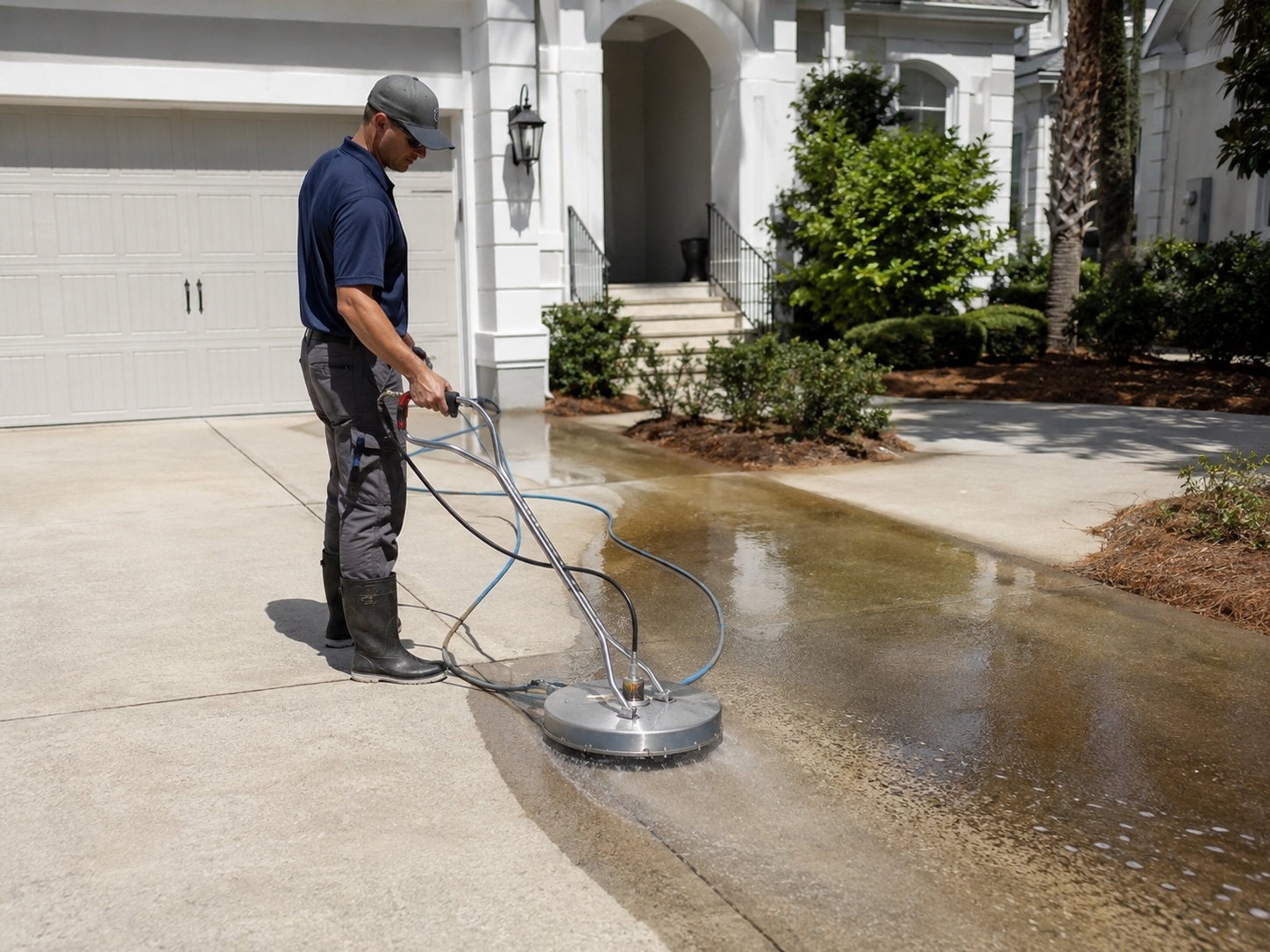
Concrete driveways can generally handle far more pressure than siding or painted surfaces, but “more pressure” isn’t the whole answer. Most stains — oil, algae, rust, efflorescence — need the right cleaner and dwell time before the pressure washer ever does the rinsing. A surface cleaner attachment, held at a consistent distance and moved in slow, overlapping passes, gets an even result without the striping or gouging a wand alone can leave behind.
A driveway takes more daily abuse than almost any other exterior surface — tires, oil drips, sprinkler overspray, tree sap, foot traffic, and whatever the weather leaves behind. Unlike siding, concrete and pavers can generally tolerate higher pressure, which is exactly why driveway cleaning gets treated as its own topic instead of a smaller version of house washing. Here’s what actually gets a driveway clean, what causes the stains that don’t come out with plain water, and where DIY attempts most often go wrong.
Why Driveway Cleaning Is Different From Siding or Patios
Vinyl siding and painted surfaces are cleaned conservatively because they’re relatively thin and can crack, dent, or trap water behind them under too much pressure. Concrete is a different material entirely — dense, load-bearing, and built to be driven and walked on. That’s why driveway cleaning typically uses a higher pressure range than siding, and why a flat surface cleaner attachment (rather than a single narrow spray tip) is the standard tool: it distributes pressure evenly across a wide surface instead of concentrating it in one line, which is what leads to the visible “striping” pattern on driveways cleaned incorrectly with a wand alone.
How Concrete Age and Condition Affect Safe Pressure
“Concrete” isn’t one uniform material — a driveway poured five years ago and one poured twenty-five years ago don’t necessarily handle the same pressure the same way. Newer concrete is typically denser and more uniform, which gives it more tolerance for a stronger clean. Older concrete has usually gone through more freeze-thaw cycles, more UV exposure, and more everyday wear, so it’s more likely to have hairline cracks, surface pitting, or spalling (small flakes or chips coming off the top layer) that aren’t always obvious until water and pressure are added. Pushing high pressure into an already-weak spot doesn’t just fail to clean it better — it can peel away loose material and turn a small cosmetic issue into a bigger repair. A quick visual check before washing — looking for cracking, flaking, discoloration that might indicate moisture underneath, or edges that feel soft or crumbly underfoot — is worth the two minutes it takes, because it tells you whether to treat the whole driveway the same way or dial back pressure in specific sections.
Step by Step: What a Proper Driveway Wash Actually Involves
- Clear and pre-rinse — sweep loose debris and give the surface a plain-water rinse so cleaner isn’t wasted lifting loose dirt
- Pre-treat visible stains — apply a concrete-safe degreaser directly to oil spots and let it sit (dwell time) so it can break the stain down before any water hits it
- Apply an overall cleaning solution — for algae, mildew, and general grime across the full surface, not just the stained spots
- Agitate stubborn spots — a stiff brush on set-in oil or rust helps the cleaner work into the pores of the concrete
- Rinse with a surface cleaner — slow, overlapping passes at a consistent distance from the concrete, working toward a drain point so wash water doesn’t pool
- Spot-check while wet — stains often look different wet than dry; a second pass on anything still visible is easier before everything dries
Surface Cleaner vs. Wand: Which Should You Use?
A wand with a narrow-angle nozzle concentrates all of a pressure washer’s force into a small point, which is exactly what makes it risky on a wide, flat surface like a driveway — even a steady hand tends to move at an inconsistent speed, and any hesitation leaves more pressure on one spot than the next. That inconsistency is what produces the light and dark banding some homeowners notice after a DIY wash: it’s not dirt left behind, it’s uneven cleaning intensity across the surface. A surface cleaner solves this by spinning two or more nozzles under a flat, enclosed housing that rides just above the concrete, spreading the same pressure evenly across a wider path with every pass. It’s also faster for large areas and safer, since the enclosed design keeps overspray and debris from kicking back at the operator. A wand still has its place — edges, corners, garage door tracks, and tight spots along the driveway’s perimeter that a surface cleaner can’t reach — but for the open field of the driveway itself, the surface cleaner is the tool that produces a clean, even result instead of a striped one.
What’s Actually Causing That Stain?
Not every dark mark on a driveway is the same problem, and treating the wrong one the wrong way wastes time. Here’s a quick reference for the most common driveway stains:
| Stain Type | What Causes It | What Actually Removes It |
|---|---|---|
| Oil / grease | Vehicle drips, parked equipment | Degreaser with dwell time, then agitation, then rinse — plain water alone rarely fully clears it |
| Algae / mildew | Shade, moisture, poor drainage | A cleaning solution formulated for organic growth, followed by a full rinse |
| Rust | Metal furniture, fertilizer, irrigation equipment | A rust-specific concrete cleaner — degreasers won’t touch it |
| Efflorescence (white, chalky haze) | Mineral deposits rising through the concrete | A mild acidic cleaner made for concrete; aggressive scrubbing alone won’t fully clear it |
| General gray buildup | Dirt, pollen, tire residue, everyday traffic | Straightforward pressure washing with a surface cleaner — usually the easiest of the group |
Oil is the one homeowners ask about most, and it’s also the one most likely to disappoint if you skip the degreaser step. Oil soaks into porous concrete rather than sitting on top of it, so blasting it with water alone tends to lighten a stain without fully removing it. Timing matters too: a fresh spill is easiest to handle by covering it with an absorbent material like cat litter or baking soda for a few hours before it has a chance to soak in deeper, then sweeping it away before the driveway is ever pressure washed. A stain that’s had months or years to set in is a different job — it may need a stronger degreaser, a longer dwell time, or more than one treatment pass, and some deeply baked-in stains never come out completely no matter what’s used. Setting that expectation up front avoids the frustration of assuming any oil stain should disappear in a single wash.
What Can Go Wrong With DIY Driveway Cleaning
- Etching or “striping” the concrete from holding a narrow wand tip too close or too long in one spot
- Uneven cleaning that leaves visible lines or patches where passes didn’t overlap consistently
- Pushing oil or degreaser residue into a storm drain, which is a real environmental and regulatory issue, not just a cosmetic one
- Using too high a pressure setting on older, already-cracked, or spalling concrete, which can worsen existing damage
- Skipping pre-treatment on oil or rust and assuming the pressure washer alone will finish the job
Homeowner Checklist: Before You Rent a Pressure Washer
Worth confirming before you start:
- Is your concrete in good condition, or are there existing cracks, spalling, or crumbling edges that higher pressure could worsen?
- Do you know what’s actually causing each stain — oil, rust, algae, or efflorescence — since each needs a different approach?
- Do you have a plan for where the wash water goes, especially near a street, storm drain, or slope toward a neighbor’s property?
- Do you have the right attachment (a surface cleaner, not just a wand) for an even result on a large flat area?
- Is the driveway sealed? A sealed surface generally cleans easier and resists staining better than bare concrete.
If you’re not sure about any of these, a couple of photos with your quote request is the fastest way to get an honest read on what your driveway actually needs.
After the Wash: Should You Seal Your Driveway?
Sealing isn’t required, but it’s worth considering right after a thorough cleaning. A concrete sealer adds a protective layer that makes future oil drips, tire marks, and organic growth easier to rinse away, and it can extend the time between deep cleanings. It’s not a one-time fix — most sealers need reapplication every couple of years depending on traffic and sun exposure — but for a driveway that stains easily or sits in a shaded, damp spot, it’s a reasonable next step once the surface is clean.
When to Get Help
Renting a pressure washer for a single driveway is a realistic DIY project for a lot of homeowners — the risk isn’t the equipment, it’s matching pressure, technique, and cleaner to the actual stain. Rental units also vary widely in how they’re set up: some let you fine-tune pressure and nozzle angle easily, while others are more all-or-nothing, which makes it harder to back off in exactly the spots (older concrete, edges, expansion joints) that need it most. Wash water is also a genuine regulatory consideration, not just a cosmetic one: the EPA’s NPDES Stormwater Program covers how wash water and runoff are expected to be managed so it doesn’t carry oil, sediment, or cleaning chemicals into storm drains and local waterways — something a rented machine and a driveway slope toward the street won’t manage on their own.
Professional cleaning tends to make more sense once a job has more than one of these factors working against it: heavy or long-set staining that needs a stronger, correctly matched cleaner; older or visibly cracked concrete where the wrong pressure could cause real damage instead of just a mediocre clean; a driveway that slopes toward a storm drain, street, or neighbor’s property with no easy way to contain runoff; or simply not having the time to do the pre-treatment and multi-pass process a stubborn stain actually needs. None of that means DIY is a bad choice for a driveway that’s in good shape with only light, everyday buildup — it just means the calculation changes once damage risk or runoff control becomes a real concern. See our Pressure Washing in Myrtle Beach page for how we approach driveways and concrete specifically — it’s a different process than the gentler soft washing approach we use on siding.
Not Sure What’s Actually Wrong With Your Driveway?
Send a few photos of the stains you’re dealing with and Budget Boss can help you figure out what’s actually causing them — no phone call required.
See our Pressure Washing in Myrtle Beach page, or read How Often Should You Pressure Wash Your House? to see how driveway cleaning fits into a regular maintenance schedule.
Frequently Asked Questions
What PSI is safe for cleaning a concrete driveway?
Concrete generally tolerates a higher pressure range than siding or painted surfaces, but the right setting also depends on the concrete’s age and condition. Older, cracked, or spalling concrete should be cleaned more conservatively than a newer, solid driveway.
Will pressure washing alone remove oil stains?
Usually not completely on its own. Oil soaks into porous concrete, so the most reliable results come from a degreaser with dwell time and some agitation before rinsing — plain water tends to lighten an oil stain rather than fully clear it.
Can pressure washing damage a driveway?
Yes, if the pressure is too high for the concrete’s condition or a narrow wand tip is held too close in one spot for too long. That’s what causes the etched or “striped” look on some DIY jobs.
How often should a driveway be pressure washed?
It depends on shade, drainage, and how much oil or organic growth builds up, but many homeowners find once or twice a year keeps stains from setting in deeply. See our full breakdown in How Often Should You Pressure Wash Your House?
Is it legal to let driveway wash water run into the street or storm drain?
Generally, no — wash water can carry oil, sediment, and cleaning chemicals that aren’t supposed to enter storm drains untreated. The EPA’s NPDES Stormwater Program outlines the framework behind why runoff containment matters, and local ordinances often add their own specific rules.