A surface-aware clean built around Charleston's coastal humidity, salt air, and historic-district homes — matched to your driveway, siding, brick, or roof, not a single blast of pressure for everything.
Pressure washing in Charleston generally means matching the cleaning method to the surface — higher pressure for durable areas like concrete driveways, and a gentler, lower-pressure soft-wash approach for siding, stucco, and roofing. Charleston's humidity, salt air, and dense oak canopy encourage algae and mildew to build up quickly, and the city's historic district calls for extra care so the cleaning method doesn't damage delicate exterior materials.
Charleston's relative humidity runs roughly 67–79% year-round, so the coastal air rarely dries out for long. Combined with salt-laden breezes off the harbor and the deep shade cast by the city's live oak canopy, exterior surfaces here tend to collect grime, algae, and mildew faster than they would in a drier inland climate.
Salt-laden coastal air is corrosive to metal fixtures, railings, and fasteners — strongest near the water but reaching well inland on humid, windy days.
Shaded, north-facing walls under Charleston's dense oak canopy stay damp longest, so algae and mildew tend to show up there first.
Older painted siding, stucco, and masonry in Charleston's historic neighborhoods generally call for a gentler cleaning approach than newer construction.
Charleston's live oaks — including the famous Angel Oak on Johns Island — drop heavy, olive-colored pollen and stringy tassels each spring that coat siding, driveways, and gutters. Where those oak tannins drip across iron gates, railings, or fences, they can react with rust to leave dark staining on siding and masonry below. Atlantic hurricane season also runs June 1 through November 30, peaking from mid-August to mid-October, and many homeowners use the calm months before and after the season to clean gutters, wash off salt spray and storm debris, and address mildew before it spreads.
For homes in Charleston's historic district specifically, the City of Charleston's Board of Architectural Review maintains guidelines for exterior work that may affect historic fabric — a useful resource to check before any exterior cleaning project on a historic property.
Budget Boss cleans the surfaces that tend to need the most attention around a Charleston property — driveways, walkways, patios, brick masonry and garden walls, stucco, painted wood siding and trim, fiber-cement siding, wrought iron gates and railings, and roofing.
Charleston's building stock spans a wide range of materials, and each one behaves differently under pressure. Historic brick masonry and garden walls are common in the older neighborhoods; stucco and painted wood siding and trim show up on historic "single houses" with their signature piazzas and porches; cypress and other tannin-rich woods appear in trim and shutters; wrought iron shows up in gates, fences, and railings; and newer construction around the area increasingly uses fiber-cement (Hardie) siding. Knowing which material is in front of us is the first step in deciding how to clean it.
Not every surface gets the same treatment. Durable concrete generally tolerates higher pressure well, while painted wood siding, stucco, soffits, and asphalt shingle roofing typically call for a soft-washing approach — lower pressure paired with a cleaning solution — since high pressure risks stripping paint, etching stucco, or driving water behind materials it isn't meant to penetrate.
For a full explanation of when a gentler approach makes sense, see What Is Soft Washing and When Should You Use It? — and if vinyl siding is part of your project, Is Pressure Washing Safe for Vinyl Siding? covers that surface specifically.
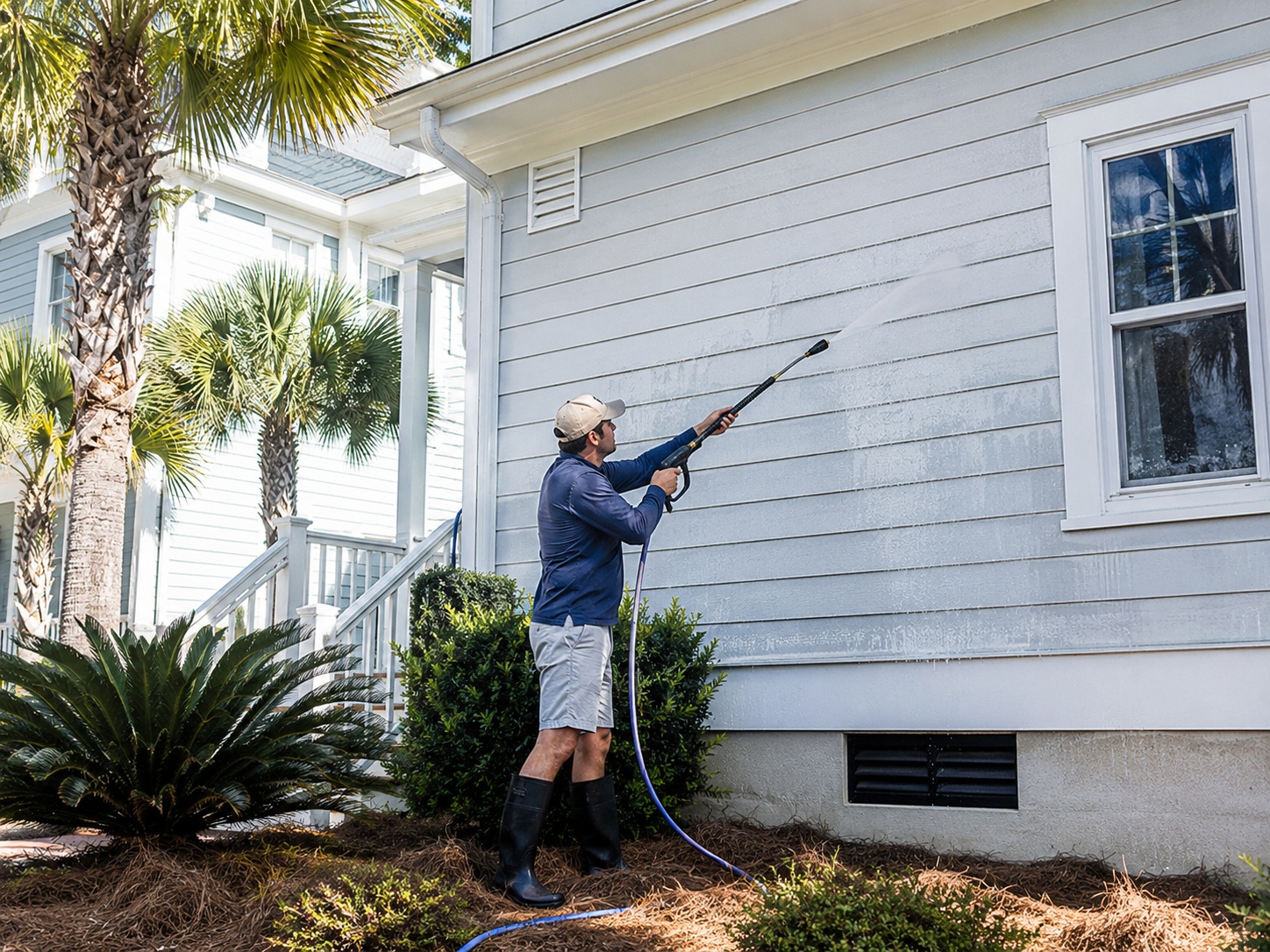
Surfaces that typically call for lower pressure and a surface-aware technique around Charleston homes:
A quick visual guide to how Budget Boss thinks through the most common surfaces around Charleston properties — the concern that typically shows up first, and the general approach that fits it. This is a qualitative guide, not a measurement tool.
The same guidance in table form, for a quick side-by-side comparison across all the surfaces Budget Boss commonly addresses around Charleston properties.
| Surface | Common Concern | Typical Approach |
|---|---|---|
| Concrete / Driveway | Embedded dirt, tire marks, oil stains, shaded algae | Tolerates higher pressure; pretreat oil & grease spots |
| Brick | Surface grime, efflorescence, mossy mortar joints | Gentler pressure — mortar is softer than the brick face |
| Stucco | Dirt buildup, mildew & algae staining | Soft-wash standard; porous texture can crack under high pressure |
| Wood siding / trim | Gray weathering, mildew & algae, worn paint | Gentler soft-wash approach to protect grain & finish |
| Vinyl siding | Green/black algae streaking, chalking | Soft-wash standard; avoids forcing water behind panels |
| Pavers | Algae/moss in joints, oil spots, fading | Moderate pressure at an angle; avoid blasting out joint sand |
| Roof (shingle/tile) | Black algae streaking, moss or lichen | Soft washing — industry-standard, manufacturer-approved method |
A few simple steps before Budget Boss arrives help the job go smoothly and protect anything near the work area.
Describe your surfaces and upload photos if available — no phone call required.
Budget Boss reviews the details and follows up with a fast quote.
A cleaning method matched to each surface, not a single pressure setting for the whole property.
A final rinse and a look-over before the job is considered done.
Timelines vary by property size, the number of surfaces included, and how much prep or pretreatment a job needs — a single driveway is a quicker visit than a full exterior with siding, brick, and roofing. There's no guarantee on how long buildup stays away afterward. Charleston's humidity and oak-canopy shade mean algae and mildew can return, and how quickly depends on your home's sun exposure, tree cover, and overall condition — which is also why many homeowners plan a cleaning before and after hurricane season rather than expecting a once-and-done result.
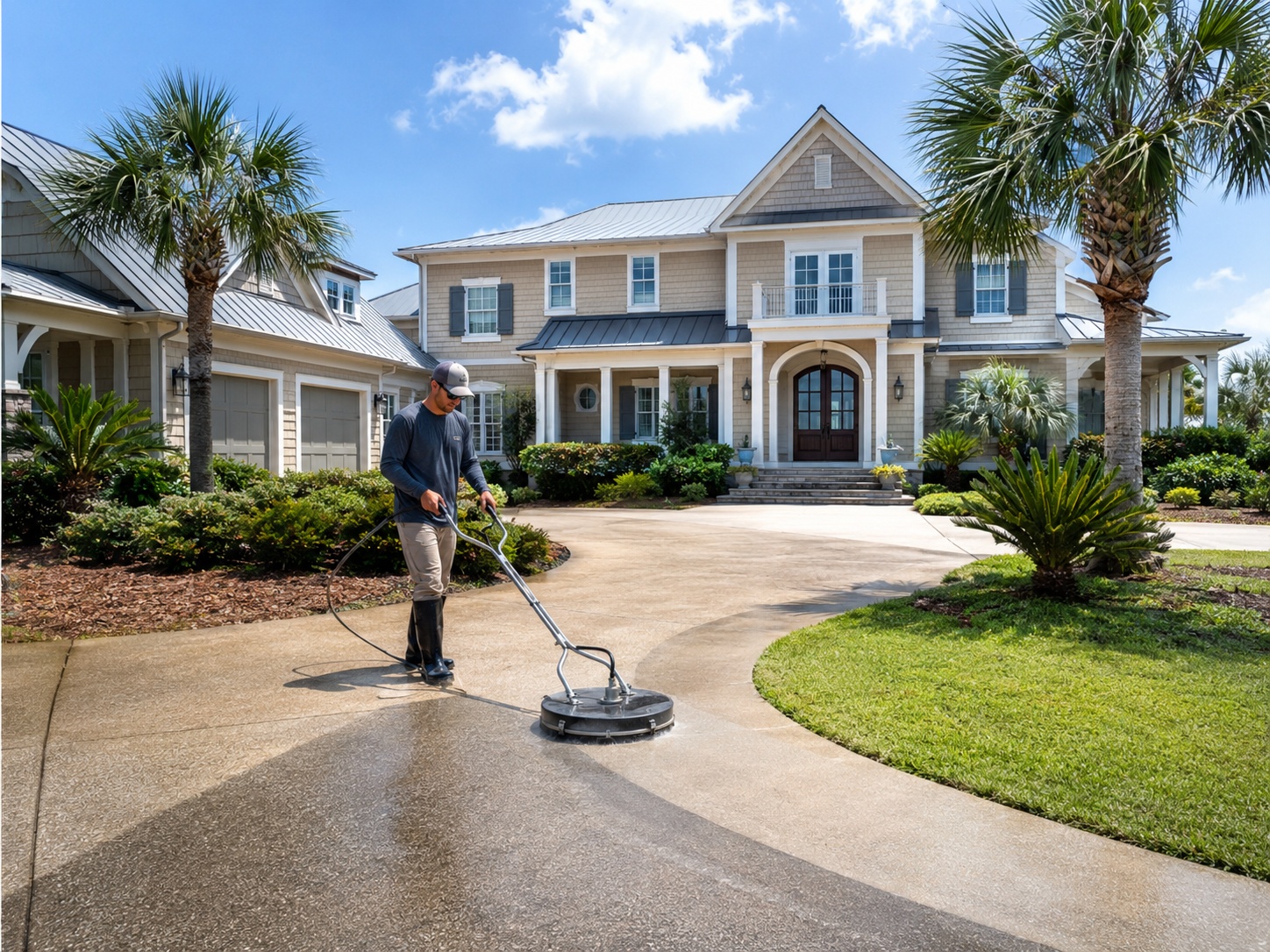
A short walk-through of the property beforehand — clearing driveways, closing windows, and flagging any delicate landscaping — is usually all the preparation needed. For a full room-by-room and yard walkthrough, see What Should You Do Before Pressure Washing Your House?
It typically starts with an assessment of each surface — driveway, walkway, siding, brick, or roof — followed by a cleaning method matched to that surface. Durable areas like concrete can usually handle more pressure, while siding, stucco, and roofing generally call for a gentler, lower-pressure soft-wash approach.
Not on every surface. Painted wood siding, stucco, soffits, and asphalt shingle roofing can be damaged by high pressure, so historic-district homes typically call for a soft-washing approach. Brick tolerates more pressure than siding, but older mortar and coatings still need a careful touch.
Charleston stays warm and humid most of the year, and that moisture — combined with salt-laden coastal air and shade from live oak canopy — encourages algae and mildew growth on exterior surfaces faster than in drier inland climates.
Yes. Historic-district homes generally receive extra care with a soft-wash approach on delicate surfaces. For work that may affect historic fabric, the City of Charleston's Board of Architectural Review is a helpful resource to consult.
Fill out the online quote form below, describe what needs cleaning, and upload photos if available so Budget Boss can review the job and follow up with a fast quote — no phone call required.
Not necessarily — as long as Budget Boss has access to the exterior areas being cleaned and any required water source, confirmed ahead of the appointment.
This list is maintained by Budget Boss and updated as new content is published — it's a curated set of related guides and service pages, not a live feed.
Tell us what needs cleaning around your Charleston property and upload photos if available — no phone call required.
Tell us what needs cleaning around your Charleston property and upload photos if available — no phone call required.
Request a Quote